


Movie scene analysis, the intricate art of capturing visual stories plays a pivotal role in shaping our perception of films. Photography analysis, creates profound images that linger in our minds long after the credits roll. This photo critique delves into the rich visual elements of the series “Westworld,” providing an in-depth photo critique that goes beyond superficial interpretations. Through this analysis, we penetrate the depths of history and art, relationship between philosophy in photography and its mystery.
uncovering the subtle nuances that define the cinematic sequences of the show. Join me as we traverse the world of visual storytelling, where each frame testifies to the power of movie scene analysis.
Anomaly Detection
It’s quite clear that a control system is constantly monitoring everyone. It even seems that our protagonist, Caleb Nichols, is being controlled even in his sleep.
I begin my analysis with these sentences to convey that what you’ve seen and understood in the series “Westworld” is only a fraction of your own interpretation.
My name is Ali Saadat, a thinker and writer in the field of discovering relationships and critiquing photographs from historical and visual communication perspectives. The work I do is a movie scene analysis.

Finding a suitable method to implement photography analysis in cinematic scenes took a considerable amount of time.
Let’s take you through my own perspective on the cinematic sequences, bringing you into a world that I’m confident you’ll find captivating. Just forget about the superficial viewpoints for a moment, and together with the writer and director, we will delve into the depths of history and art.
Photo critique will be very enjoyable and appealing for individuals like you who are currently reading this article using my method.
For uncovering a movie scene analysis, or better yet, presenting a photo critique, examining a cinematic sequence, in my opinion, requires reviewing and revisiting the preceding sequences and possibly even the subsequent ones to write about it accurately.
Prison of Loneliness
In an extraordinary sequence, Caleb Nichols descends into the depths of a vast building with many floors and old staircases.
This building seems to symbolize a prison—a modern prison built by workers like Caleb Nichols, which now incarcerates them. To support this point, we might look at the following sequence where Caleb ascends on an escalator, symbolizing modernity, and gazes at the ceiling.

From the perspective of photo critique, placing such a scene in the image has been purposeful and intentional.
A ceiling that doesn’t show the sky but instead is replaced by an aquarium with red fish. The fish symbolize freedom, while the aquarium with its confined waters serves as a metaphor for the sky, showcasing the filmmakers’ high level of philosophical and artistic design.

“Movie scene analysis” finds its true meaning here from my perspective. The significance of this is highlighted by the dialogue between Caleb Nichols and his intelligent advisor.
Technology Over Military Design
In this dialogue, the advisor asks Caleb Nichols: “How was it being there? Being at home?” This refers to a project involving the military, where Caleb served as a soldier in Westworld.
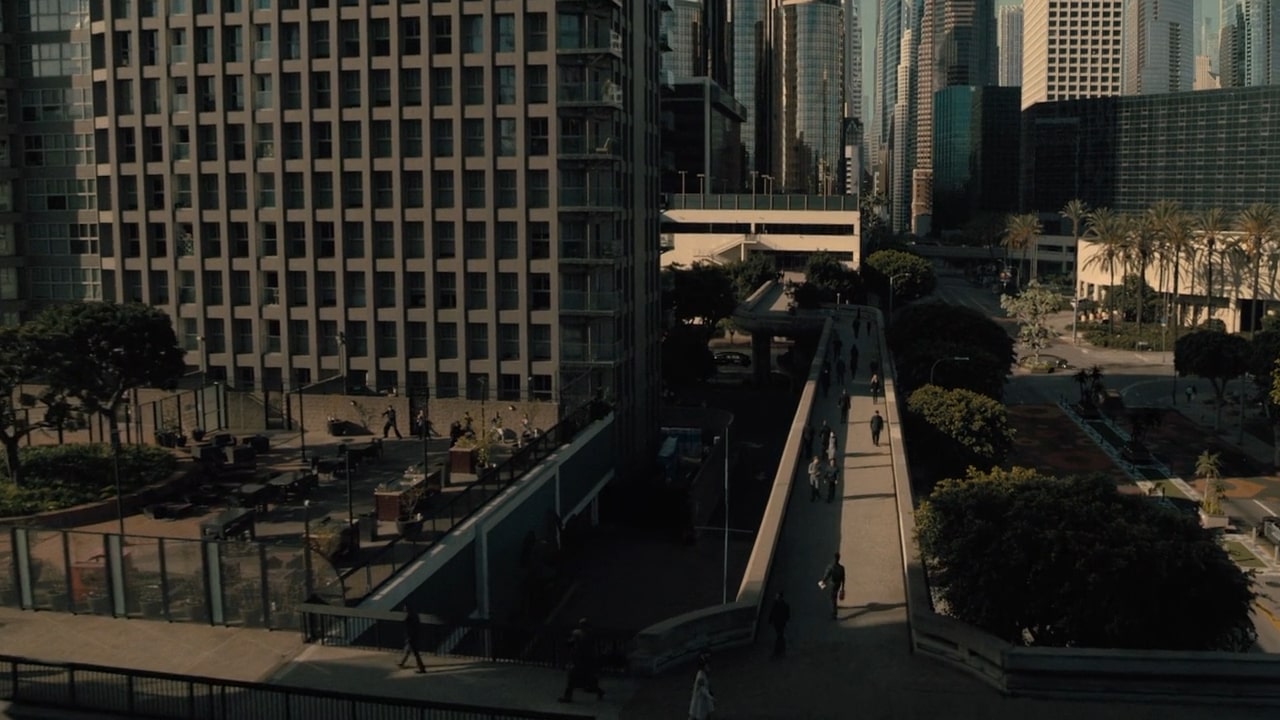
Caleb responds: “Here? I don’t know. In a way, the military was run by algorithms, making everything turn out as it was supposed to be (probably unpredictable and based on factors that were not favorable or intended by the system). It’s better to live with technology.”
Here, technology seems to be more dangerous than the military scheme. When we look at scenes from the perspective of photography analysis, we discern the meticulous artistic approach the director has taken. I imagine that in different modes of Movie scene analysis we can discover many points.
Presence of the Sky
In this sequence, Caleb Nichols, representing humanity in the modern world, appears very small and isolated amidst the large modern urban elements, showcasing human loneliness and monotony.

Let me introduce a beautiful point so you won’t be shocked at the end: Caleb Nichols holds two packages in his hands.
In his right hand, there’s a red box, which isn’t the focus of my discussion but symbolically could be a toolbox, highly significant in this context.
In his left hand, there’s a white package, which is his lunch, and I emphasize its great importance.
Today’s Prison
In this part, a number of martial artists practicing moves, with a clear reference to East Asian martial arts, hold great importance due to the camera’s continuous focus on them.
Today, maybe we can find such elegance in very special movie sequences. These cases show us how important movie scene analysis is.
Their training environment is designed in a way that resembles a prison. The tall walls surrounding them and the wire mesh fences in front suggest confinement. In a way, the environment can be likened to a psychiatric hospital.
Leave Hard and Dangerous Work to Your Colleague. He’s a robot.
However, this robot is also a prisoner with its key in Caleb Nichols’ hands. Despite not asking for a loan or consuming food, it takes on dangerous tasks and is as productive as several people.

What beautiful and subtle references are made to human emotions, needs, pains, and concerns.
Here, I’d like to point out an important aspect seen in the Matrix trilogy, an outstanding work by the Wachowski sisters. In a scene with Keanu Reeves as Neo and Anthony Zerbe as Counselor Hamann, they discuss whether we need machines or they need us. You can read my detailed movie scene analysis in a separate critique.
I will share my photography analysis with you for all the scenes I come across.
Golden Sequence of Westworld, A Reminder of the World’s Development History
In this sequence, Caleb Nichols sits with his colleague on a crane at a height, eating lunch and talking with his ever-present advisor, while the silent and calm robot colleague represents Caleb’s isolation under the control of technology.

The background of this scene reveals a cityscape with towering buildings. Doesn’t it remind you of a famous photo?
Yes, the iconic photo of workers eating lunch in 1923 New York, atop the Rockefeller building. Workers eating fearlessly at a height without any concern for their safety.
This beautifully bridges the past with about a century ago. How insightful a film-making team must be and how deep a writer can see to make such an artistic connection.
A System Deciding Human Life
In subsequent scenes, we see Caleb Nichols has a mother suffering from memory loss to the extent that she doesn’t remember her son, mirroring the relationship between Dolores’ father in season one and Caleb’s mother in season three. This clearly illustrates the creation of Homo sapiens.
I promise you’ll enjoy my movie scene movie scene analysis on this particular topic as well.
Final Analysis:
Human development
– It appears both events are deeply connected to the theme of human development. An event marks the post-Great Depression development era in America, showcasing rapid industrialization and economic growth. This era saw significant advancements in technology, infrastructure, and societal organization, symbolized by the construction of iconic structures like the Rockefeller Building.
The photograph of workers fearlessly eating lunch atop this skyscraper encapsulates the spirit of human ambition and resilience, showcasing the determination to build and progress despite risks and hardships.
New forms of control and isolation
Conversely, the second event underscores the unforeseen consequences and potential disasters resulting from a century of such development. As technology has advanced, it has brought about new forms of control and isolation, exemplified by the world depicted in Westworld.
The series depicts surveillance and manipulation in a tech-driven society, revealing downsides: dehumanization, loss of autonomy, and loneliness.
I suggest you to read my analysis in the context of one of the disasters of history caused by governments. One of the bravest photo projects I have seen in my life.
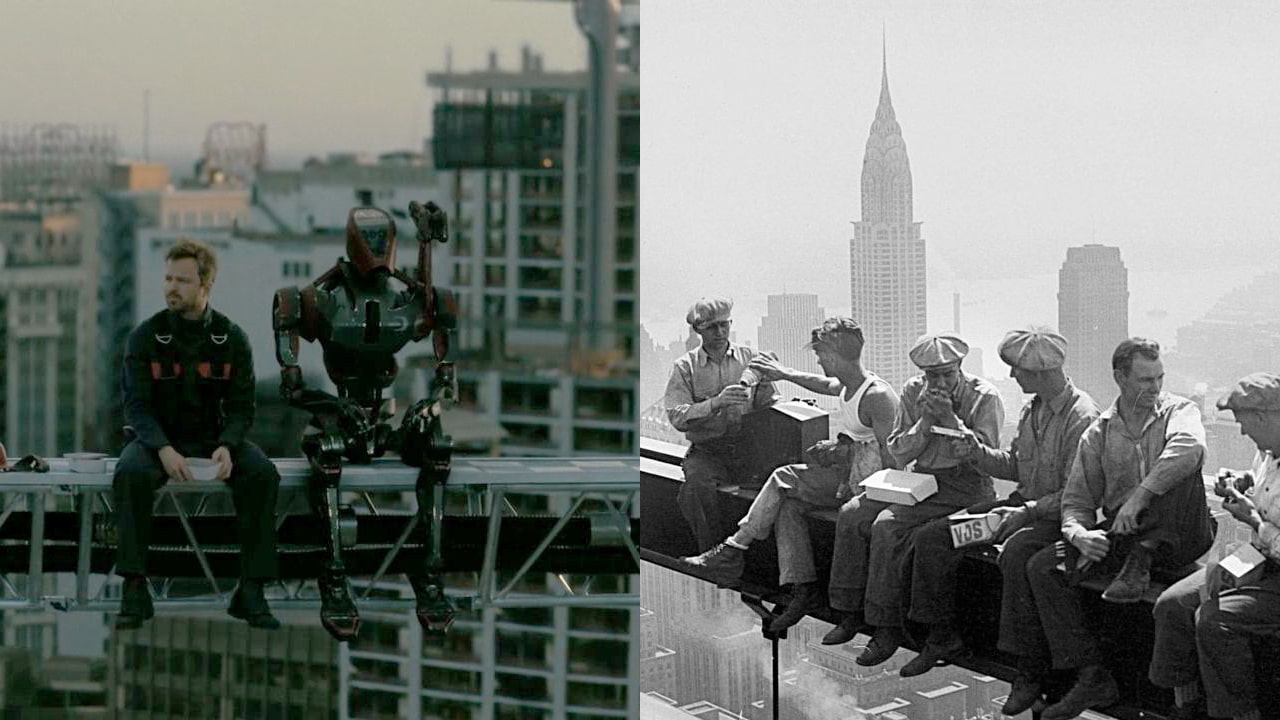
The contrast between these eras reflects on the cyclical nature of progress, raising questions about technology’s liberating or controlling influence.
Cultural and developmental icons
In 1932 and beyond, New York City and Los Angeles symbolize public hope, but for international workers, they signify exploitation and marginalization.
Unsafe working conditions
Hindered by language barriers, cultural differences, and discriminatory practices, these workers often find themselves at the mercy of unscrupulous employers, facing low wages, unsafe working conditions, and limited access to essential resources.
Despite their integral role in fueling the economic engine of these cities, their voices are frequently silenced, their struggles overlooked, and their rights disregarded.
Thus, while New York City and Los Angeles City may shine as beacons of hope for many, for these modest international workers, they represent a harsh reality of systemic inequality and injustice.
International workers at the Rockefeller building epitomize the diligent labor class, merging diverse skills to construct an iconic New York landmark.
Their collective labor under harsh conditions and often perilous heights is a testament to their resilience and dedication. Despite shaping the city’s skyline and economy, workers’ names and contributions are often undocumented, rendering them invisible in history.
Indeed, workers’ invisibility mirrors society’s tendency to overlook the labor class, despite being the backbone of development.

Modern-day allegory
Similarly, in the series “Westworld,” Caleb Nichols and his robot colleague represent a modern-day allegory of the working class. Caleb and his robot highlight labor’s evolution under surveillance, symbolizing exploitation in a tech-driven society.
The juxtaposition of Caleb and his robot colleague emphasizes the enduring themes of labor and control. Caleb’s interactions with the tireless robot highlight workers’ struggles and raise questions about labor’s future amid automation.
Appreciation of the contributions of workers
This parallel between the historical construction workers and the characters in “Westworld” serves to underscore the persistent and evolving challenges faced by the labor class across different eras.
It emphasizes valuing and supporting workers’ contributions, prompting a reevaluation of societal recognition and support for their essential labor.
– Past humans have longed to escape life’s challenges alongside others.
Certainly! Here’s the revised sentence with added transition words:
“In general, these challenges and problems have been more prevalent among the lower classes, particularly the working class. Specifically, issues such as economic inequality and social injustice disproportionately affect those in lower socioeconomic strata.”
Throughout history, these individuals have faced significant hardships, from grueling labor conditions to economic instability and social inequities. They sought solace and strength in community and collective action, understanding that unity was their best defense against the oppressive forces of their times.

However, in today’s world, it seems the solution to these challenges has manifested in human isolation. As technological advancements and societal changes continue to reshape our lives, the sense of community that once provided support and solidarity is diminishing. Automation and Technology revolution, while offering convenience and efficiency, have also led to a more fragmented and individualized society. The very technologies that promise to connect us often leave us feeling more isolated and disconnected from those around us.
Being under constant surveillance and control
Particularly evident in the lives of modern workers, who, like Caleb Nichols and his robot colleague in “Westworld,” find themselves under constant surveillance and control. They are mediated by technology, and personal connections are overshadowed. The result is profound alienation, facing life’s challenges alone instead of with others.
This shift urges us to reconsider community and connection as technology diminishes human interaction. It encourages reflecting on how to restore solidarity and support that have historically empowered the working class.


